

This Implantation Elixir has only 4 Ingredients BUT Does About a Million Things
Whether you are trying to conceive naturally or doing an IUI or IVF, we all want our embryo to STICK. Women who are experiencing the Two-Week-Wait aka….the worst 10-14 days of your life want that carefully placed embryo to nestle into your uterus and IMPLANT. We also need a beautiful juicy thick endometrial lining. Many of my clients have had IUI and IVF transfers due to thin lining.

Whether you are trying to conceive naturally or doing an IUI or IVF, we all want our embryo to STICK. Women who are experiencing the Two-Week-Wait aka… the worst 10-14 days of your life, want that carefully placed embryo to nestle into your uterus and IMPLANT. We also need a beautiful juicy thick endometrial lining. Many of my clients have had IUI and IVF transfers due to thin lining.
Let me break down why this elixir is a winner.
Beets: Beetroot contains nitric oxide, which dilates blood vessels allowing a rich supply of oxygenated, nutrient-rich blood to flow to the uterus. YES! Its intake starting a week or two before an embryo transfer or IUI day may improve embryo implantation into the uterus (1). Beets improve circulation that can aid in thickening the uterine lining.
Watermelon: L-Citrulline in watermelon, may improve vascular function through increased L-arginine bioavailability and nitric oxide synthesis (2).
Ginger: A powerful antioxidant that is great for reducing inflammation.
Lemon Juice: Packed with essential vitamins, nutrients, and minerals. It also balances out the flavors.
Sending fertility love 💗 and baby dust!
Love, your fertility sister...Kira
Let’s talk about boosting your fertility.
Book a free 20-minute fertility strategy session call.
References:
Halpern, G., Setti, A. S., de Almeida Ferreira Braga, D. P., Iaconelli, A., & Borges, E. (2019). Beetroot, watermelon and ginger juice supplementation may increase the clinical outcomes of intracytoplasmic sperm injection cycles. Fertility and Sterility, 112(3). https://doi.org/10.1016/j.fertnstert.2019.07.1334
Figueroa, A., Wong, A., Jaime, S. J., & Gonzales, J. U. (2017). Influence of L-citrulline and Watermelon Supplementation on vascular function and Exercise Performance. Current Opinion in Clinical Nutrition & Metabolic Care, 20(1), 92–98. https://doi.org/10.1097/mco.0000000000000340

Can Being Overweight or Underweight Affect My Fertility? You Will Be Shocked By the Answer.
Who is at greater risk of fertility issues, a woman who is overweight or underweight? Drum roll…...BOTH. Yup, women and men who are on either side of the spectrum of the scale can have issues conceiving. If you are interested in how body weight can affect fertility, keep reading on!

If you are on the lower or higher end of the scale, this can affect your fertility.
Who is at greater risk of fertility issues, a woman who is overweight or underweight? Drum roll…...BOTH. Yup, women and men who are on either side of the spectrum of the scale can have issues conceiving. If you are interested in how body weight can affect fertility, keep reading on!
In research and medicine, body weight is normally classified as being underweight, normal weight, overweight, or obese based on the body mass index (BMI) scale. Take a look at the BMI categories below:
<18.5 kg/m2 = underweight
18.6 - 24.9 kg/m2 = normal weight
25 - 29.9 kg/m2 = overweight
>30 kg/m2 = obese
Remember, BMI is not perfect, as it does not take into account how much muscle mass a person has (& muscle weighs more than fat!). Here at Nouveau Nutrition Fertility Wellness, we 100% support the health of every size. That being said, it is important to be aware of health statistics and how certain factors may influence your fertility overall.
Men, you have to watch your weight too. If you are obese, you are 3 times more likely to have a reduction in sperm quality, making it harder for the sperm to penetrate an egg. No penetration of the egg...no embryo….no baby. If you are in the overweight category, you may be at a higher risk for sperm DNA damage, leading to poor quality swimmers. An increase in BMI has also been found to decrease sperm concentration. As your weight increases, so does a hormone called inhibin B. More inhibin B in the body leads to lower sperm production. Less sperm = harder time getting pregnant. Side note - this does not apply to someone that is underweight and needs to increase their weight.
It’s not just excess weight that can kill your chance at conception, lack of weight can also influence fertility. Men who have a BMI less than 18.5 kg/m2 may also produce lower sperm concentrations than those who are at a normal BMI. Try to be in the normal range to optimize your health and that all-important SPERM.
Remember, 30-40% of all infertility cases are due to suboptimal male fertility. This is why it is important for both men and women to work on their fertility for an optimized chance at conception!
As for women, it has been found that women in the overweight and obese categories may experience a longer time to get pregnant than those who have a “normal” BMI. Obese women also have a greater risk of miscarriage. Unfortunately, it has been found that obesity lowers success rates in women undergoing in vitro fertilization (IVF). On a positive note, weight loss, even 10 pounds, has helped women improve their fertility by bringing back or regulating ovulation (which is essential to get pregnant!).
Similar to men, being in the underweight category can also damper your chances at conceiving. Having a low percentage of body fat can lead to ovarian dysfunction (abnormal, irregular, or absent ovulation) and infertility. Limited body fat can disrupt estrogen levels, thus impacting our period. Underweight women may also be at greater risk of having a premature infant. Increasing your body weight safely can help regulate your period, improve your chance at conception, and reduce the risk of having a premature baby. We have worked with women who needed to gain weight and we did that with nutrient-dense meal plans and tons of support.
Whether you are looking to lose or gain weight to improve your fertility, it is important to do so in a healthy way. Not sure where to start? Check out the contact information below and let me help you improve your fertility. As always, be sure to speak with a healthcare provider before making any changes to your diet.
If you fall on either side of the scale, let’s talk about how we can work together to boost your fertility.
Book a free 20-minute fertility strategy session call.
Sending fertility love 💗 and baby dust!
Love, your fertility sister...Kira
203.442.6027
References:
Sharma R, Biedenharn KR, Fedor JM, Agarwal A. Lifestyle factors and reproductive health: taking control of your fertility. Reprod Biol Endocrinol. 2013;11:66. doi:10.1186/1477-7827-11-66
Weight and Fertility. Reproductive Facts. https://www.reproductivefacts.org/news-and-publications/patient-fact-sheets-and-booklets/documents/fact-sheets-and-info-booklets/weight-and-fertility/. Accessed March 17, 2021.
FastStats - Overweight Prevalence. Centers for Disease Control and Prevention. https://www.cdc.gov/nchs/fastats/obesity-overweight.htm. Published March 1, 2021. Accessed March 17, 2021.
Defining Adult Overweight and Obesity. Centers for Disease Control and Prevention. https://www.cdc.gov/obesity/adult/defining.html#:~:text=If%20your%20BMI%20is%20less,falls%20within%20the%20obesity%20range. Published March 3, 2021. Accessed March 17, 2021.

Phases of the Menstrual Cycle
Ever wondered how the menstrual cycle works or why you may experience certain physical or psychological symptoms during your period? Why am I crying so much? Why do I want to kill everyone around me? Why are my jeans SO tight? Well, I am here to explain to you the 4 phases of the menstrual cycle and how they may impact you throughout the month.
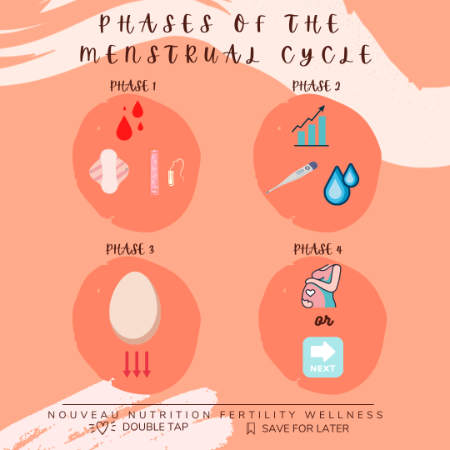
Ever wondered how the menstrual cycle works or why you may experience certain physical or psychological symptoms during your period? Why am I crying so much? Why do I want to kill everyone around me? Why are my jeans SO tight? Well, I am here to explain to you the 4 phases of the menstrual cycle and how they may impact you throughout the month.
Everyone’s cycle is different, but the average cycle lasts about 28 days. The timeline below will reflect a 28-day cycle without any hormonal birth control.
The 4 Phases of the Menstrual Cycle
Phase 1 (days 1-7): Follicular phase:
Day 1 is your first day of full flow of your period. The first phase of your cycle is called menstruation - this is when your uterine lining sheds due to estrogen and progesterone dropping. Menstruation typically lasts around 2 days to 1 week. While you are menstruating, your estrogen is slowly rising and the endometrial lining is slowly thickening. During days 1-15 ish, estrogen is higher to help release the egg.
Phase 2 (days 7-14): Follicular phase:
The second phase is the proliferative phase. During this phase, estrogen is rising slowly, which stimulates the release of another hormone called follicle-stimulating hormone (FSH). FSH stimulates the ovaries to create a follicle to prepare for ovulation (baby-making time). During this time, testosterone is also coming out to help with getting your body ready for ovulation. Testosterone rising may give you acne (which sucks), BUT it is also increasing your libido (yeah!). Towards the end of this phase; estrogen, luteinizing hormone (LH) and Basal Body Temperature (BBT) will spike (days 12-14, may vary) which causes ovulation. Your cervical mucus will also start to say “hello”- you will notice a wetter feeling ...“down there”. If you see a raw egg white-looking substance that is stretchy and slippery - that is fertility gold aka “sexy time”! Sperm can live in your body for up to 5 days, so if you are only able to be intimate once, that could be all you need.
Phase 3 (~day 14): Ovulatory phase:
This phase called ovulation can last up to 24-36 hours. Your libido should be kicked into high gear and you will notice an increase in cervical mucus. Your follicle has matured and is producing estrogen to prepare for pregnancy. An egg is released from the follicle, which travels down the fallopian tube and hopefully meets up with some sperm. If that happens, an embryo is made and it will find its “comfy safe place” called the uterine lining and hopefully implants. If the sperm and egg do not fertilize or you are not trying to conceive, the egg will dissolve and pass out of the body during menstruation.
Phase 4 (days 15-28) Luteal Phase:
The final phase is called the luteal phase. Progesterone becomes the main hormone during this phase. If pregnancy occurs, progesterone continues to stay high to support the pregnancy by getting the uterine lining ready. If pregnancy does not occur, estrogen and progesterone drop and your menstrual cycle starts all over again.
Optimal and Low Progesterone Symptoms:
Optimal: Have you ever had days leading up to your period where you feel so happy and loving…..this means your progesterone is doing its job and it is at optimal levels.
Low: Have you ever had days leading up to your period where you have wanted to yell at any and everyone???? Sounds like PMS. This indicates that your progesterone is low and you should speak to your gynecologist.
If you are experiencing any symptoms like PMS, mood swings, fatigue out of nowhere, or other symptoms, let’s talk. These can be easy fixes or can be a sign that something more serious is taking place.
Sending fertility love 💗 and baby dust!
Love, your fertility sister...Kira
203.442.6027

How Vitamin D Plays a Role in Your Fertility
Getting pregnant should be easy. Bing-Bang-Boom, right? Not the case! Turns out that some of us (including me) can have nutritional deficiencies, like vitamin D, that can make it challenging to become pregnant and stay pregnant. When I first started my fertility journey, my vitamin D was 20 ng/mL. I started to take 5000 IU of vitamin D daily and slowly it crept up to 50 ng/mL.
Thankfully, I have you covered. Keep reading to get a full dose of information.
Vitamin D deficiency is very common and it can be easy to fix. Let me throw some knowledge at my fellow sisters and brothers (sperm needs optimal vitamin D too) to boost those vitamin D levels.

Getting pregnant should be easy. Bing-Bang-Boom, right? Not the case! Turns out that some of us (including me) can have nutritional deficiencies, like vitamin D, that can make it challenging to become pregnant and stay pregnant. When I first started my fertility journey, my vitamin D was 20 ng/mL. I started to take 5000 IU of vitamin D daily and slowly it crept up to 62 ng/mL.
Thankfully, I have you covered. Keep reading to get a full dose of information.
Vitamin D deficiency is very common and it can be easy to fix. Let me throw some knowledge at my fellow sisters and brothers (sperm needs optimal vitamin D too) to boost those vitamin D levels.
Get your levels tested. Just because your favorite Instagram influencer is taking vitamin D supplements, doesn’t mean you need to pop some pills. Test, don’t guess. The gold standard test measures 25-OH vitamin D. Your individual labs will dictate if, or how much, vitamin D supplementation you might need.
Why is vitamin D SO important when trying to conceive? Well, 20-52% of women of reproductive age are deficient in vitamin D. Having optimal levels of vitamin D is crucial for:
Becoming pregnant and staying pregnant (YES!)
The process of embryo implantation
Fetal growth development
IVF/IUI- a higher chance of achieving a live birth
3. Ranges of Vitamin D:
Normal ranges are 30-100 ng/mL
Optimal levels are 50-80 ng/mL
4. How to increase your vitamin D levels:
Food sources of vitamin D: Eggs, fatty fish (salmon, mackerel, sardines), cod liver oil, dairy products, beef liver (who wants to eat liver??)
Sunshine: Take 10 minutes in the morning outside without sunscreen to allow the sun to give you a kiss of vitamin D. Did I mention it’s FREE????
Supplements: Depending on how much you need, you will want to take the active form, vitamin D3. The range can be from 500IU to 5000IU. I recommend liquid vitamin D3 supplements for the best bioavailability (it gets where it needs to go faster).
Wow! That was a ton of info!
The take-home message is: Test before you take any action. Always consult with your doctor before changing your diet or adding supplements.
My favorite supplements:
Thorne Vitamin D/K2 Liquid 1 oz (KD500)
Vitamin D-3 5000 IU 240 softgels (0373)
If you want to buy one of these supplements and receive 10% off click below. Look for the hearts ❤️, these are supplements that I love and trust.
Please, Please, Please… Do not buy any supplements from Amazon.
Sending fertility love 💗 and baby dust!
Love, your fertility sister...Kira
References:
Vitamin D - Why You Are Probably NOT Getting Enough. Dr. Mark Hyman. https://drhyman.com/blog/2010/08/24/vitamin-d-why-you-are-probably-not-getting-enough/. Published November 20, 2020. Accessed March 8, 2021.
Chu J, Gallos I, Tobias A, Tan B, Eapen A, Coomarasamy A. Vitamin D and assisted reproductive treatment outcome: a systematic review and meta-analysis. Human Reproduction. 2018;33(1):65-80. doi:10.1093/humrep/dex326